শনিবার, ৭ নভেম্বর ২০২৬
শনিবার, ৭ নভেম্বর ২০২৬

A new analysis says congestion pricing is helping buses move more reliably in Manhattan — but citywide, service is still falling short. The report from New York City Comptroller Brad Lander shows bus reliability improved by more than 9 percentage points on the 106 lines that run through the congestion zone. Express buses saw the […]
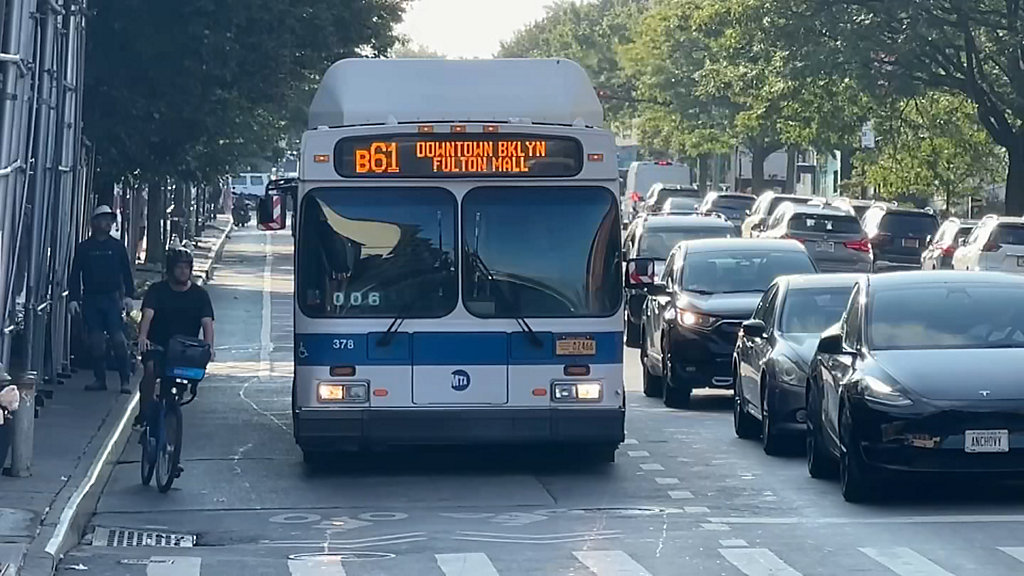
A new analysis says congestion pricing is helping buses move more reliably in Manhattan — but citywide, service is still falling short.
The report from New York City Comptroller Brad Lander shows bus reliability improved by more than 9 percentage points on the 106 lines that run through the congestion zone. Express buses saw the biggest gains in on-time performance, with reliability jumping from 58% to 69%.
But outside the toll zone, buses aren’t seeing the same improvements.
According to the report, more than half of all city bus lines still got a D or F grade, with some Manhattan routes crawling at just 5 miles per hour.
Bus riders across the five boroughs are living life in the slow lane.
“Sometimes it comes earlier, sometimes it comes later; it depends, but now since school started, they take a little longer now,” said Vanessa Morales, who was trying to get her niece to school on Friday morning.
The report looked at real-time MTA data.
The poor performance is due to buses not arriving on time for scheduled stops, and for bunching, meaning there’s not enough spacing between buses along the routes.
“The buses are like following each other, and then after that it takes like 30 minutes for the next one to come,” Morales said.
Other riders NY1 spoke to, including longtime residents, said the buses in the neighborhood have consistently been unreliable. Some also said they’ve had to deal with wait times of up to 40 minutes to catch the B61 bus.
As for the good grades, only 8% of the city’s bus lines received a B grade or higher. Also, only seven bus lines throughout the city got an A grade.
In Manhattan, nearly three out of every four buses received D and F grades. A poorer performance than any other borough is likely due to heavy traffic, which can slow some buses to as low as 5 miles per hour.
“I know the average speed in Manhattan is incredibly slow, and it’s harder; sometimes I just walk instead,” commuter Tom Griffith said.
Fifteen percent of the buses in Brooklyn are bunched. That’s a higher rate than elsewhere in the city.
Lander told NY1 in an interview Friday morning that while congestion pricing is bringing some relief, the MTA and the city need to do more to get out of the slow lane.
“If you have dedicated bus lanes, and you don’t allow them to be interrupted, then the buses can go much faster. We now have OMNY at the back of the bus, so there should be all-door boarding, so you don’t have to wait for tap after tap after tap of people getting on so slowly,” he said.
In a statement, the MTA wrote, “The MTA agrees with Comptroller Lander that faster buses are essential for riders, which is why we are undertaking all-borough bus network redesigns to speed up service with improved routing and stop spacing, expanding automatic camera enforcement, and significantly improving speeds in Manhattan through congestion relief.”
Lander also told NY1 he believes there needs to be a stronger partnership between the MTA and the city’s Department of Transportation to get buses moving faster and on time.
The comptroller added that he also believes in looking at the bus redesigns on a regular basis to evaluate performance.







বাঙালির সত্য সংরক্ষণে বাংলা ভয়েজ